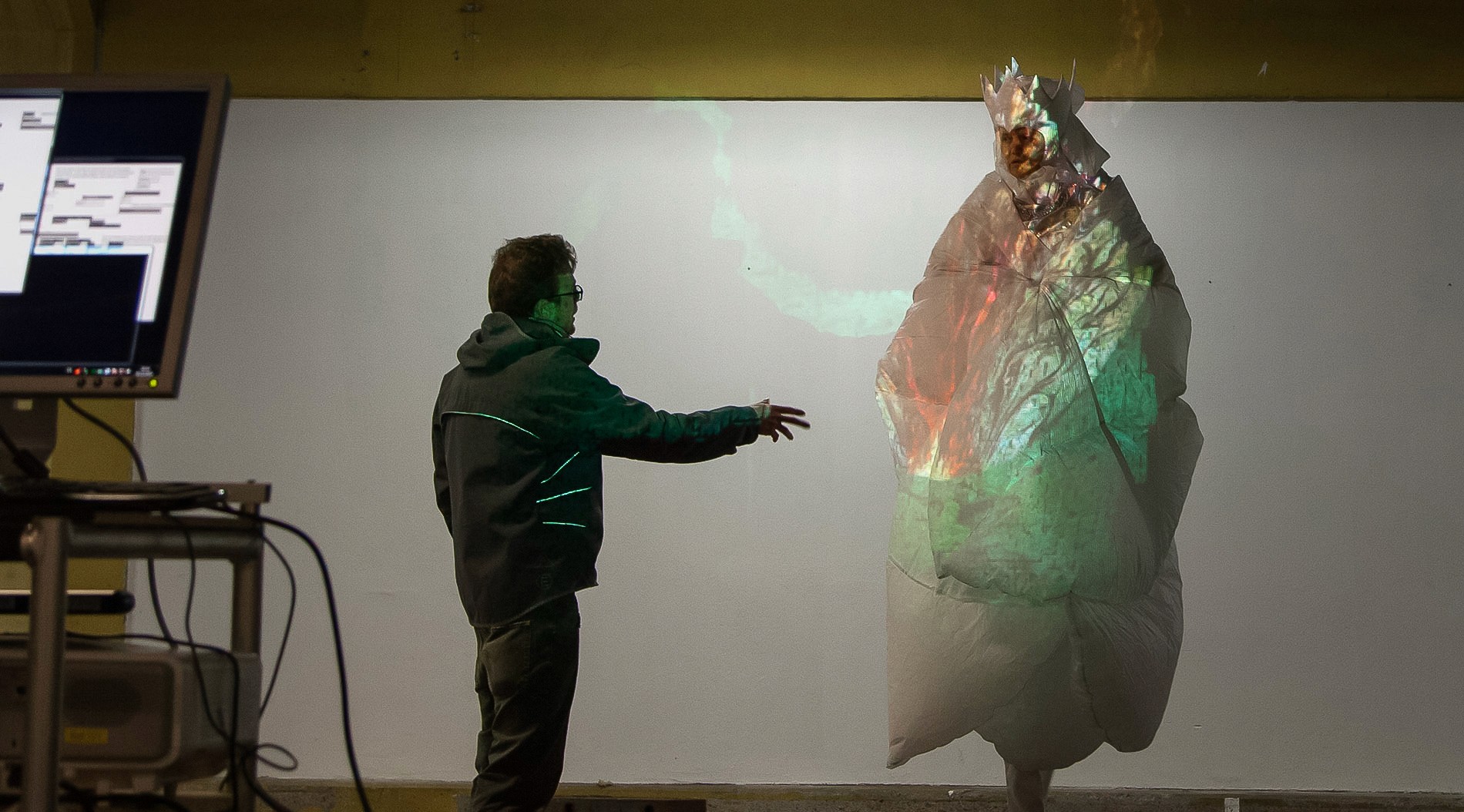
Autonomous Projection Meets AI
An autonomous projector that follows a moving subject and projects AI-generated imagery masked to their silhouette. The system integrates depth sensing, real-time masking, and StreamDiffusion-based content generation, merging the body as both subject and sensor.
The Research
Autonomous projection systems treat the body as a canvas. Raummaschine inverts this: the body becomes a sensor. A Kinect, RealSense, or LiDAR depth camera tracks movement at 30–60 Hz. It generates a depth mask that keeps projected content strictly on the subject's silhouette. Meanwhile, StreamDiffusion (a local fast-diffusion service) generates imagery at ~10–20 fps on the GPU, content rate deliberately slower than mask rate. The latency gap is hidden by the mask's precision.
Key Research Questions:
Sensor choice: depth camera type and performance trade-offs
Real-time masking pipeline at 60 Hz latency budget
Generative content under GPU constraint
Innovation
The innovation sits in the latency budget: mask updates every frame (~16 ms at 60 Hz), while content can lag 100–200 ms without breaking the perceptual illusion. This constraint becomes aesthetic. The visible 'lag' is actually the research made visible. How does constrained speed become meaningful form?
Tags: Interactive Installation, AI-Generated Content, Depth Sensing
© 2026 mojari.de