INTRO
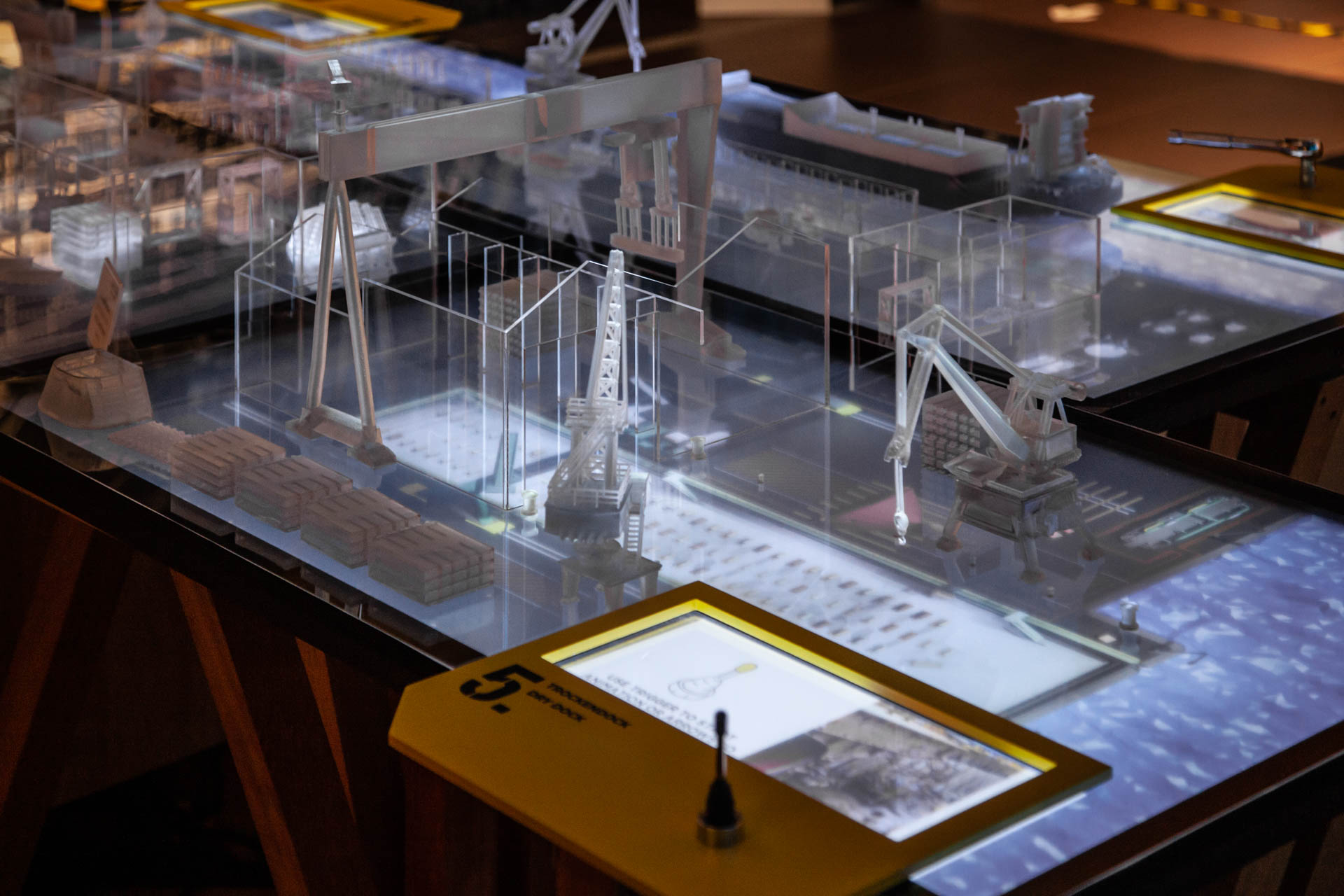
For the special exhibition “Steel and Bytes – Ein Schiff entsteht” at the German Maritime Museum in Bremerhaven, we developed an interactive model that makes it possible to experience the processes of a modern shipyard.
The heart of the exhibition are five large-format touch screens on which transparent 3D-printed and laser-cut models of an archetypal shipyard are displayed. The objects are designed in such a way that they can be staged precisely, by backlighting them with content on the screens.
At six stations, visitors can interact with typical shipyard tools, such as joysticks, handheld scanners and welding simulators, and thus call up custom-fitting information and animations on the individual processes involved in building a ship. Multilingual texts and an atmospheric sound design serve as a common thread.
Key challenges
Backlighting transparent models precisely
Industrial shipbuilding made hands-on
One sound design across all stations
NEXT TO THE COG
STEEL & BYTES opened on 1 October 2022 in the Kogge-Halle of the museum and ran until 8 March 2023. The hall is named after the Bremen Cog, a merchant ship from around 1380 that was found in the Weser in 1962. The interactive model stands close to this medieval hull, so visitors compare the shipbuilding of the Hanseatic cog directly with today's Schiffbau 4.0. The exhibition design by Veronika Stumpf draws on the museum's historical shipbuilding exhibits and frames the digital shipyard as part of that longer line.
The museum's press release describes ship and stations in detail; more on Xenorama's project page and in the mojari blog.
The shipyard follows one real vessel, the container feeder NEUENFELDE: 143 metres long, 22.5 metres wide, with a draught of 8.7 metres, built from around 33,000 tonnes of steel over 20 months. Station by station, visitors work through its construction from the first design to the launch.
Building a ship, said museum director Prof. Dr. Ruth Schilling at the opening, is “a complex undertaking and above all a collaborative project”. The exhibition was one too: the museum developed it with the Fraunhofer Institute for Large Structures in Production Engineering (IGP) in Rostock, the shipping company Reederei Bartels and Xenorama – Studio für Audiovisuelle Kunst, Potsdam.


CREDITS
Visuals & Animation: Xenorama
Music & Sound: Xenorama
Support Music & Sound: Ertan Çetin
Exhibition Design: Veronika Stumpf
Support Technical Setup: Erik Wälz
Support programming: Timo Johannes, Neo Chung
Support Model Building: Camila Mejia, Erik Wälz
3D Print: 3DHB